Old Javanese names of this period often combined Sanskrit honorifics with local Javanese roots. Royal names frequently carried the prefix Rakai or Rakrayān (regional chief/lord), Śrī (divine luster), Dyaḥ (honorific for nobility), or Pu (a common honorific for men). Women of high rank used Śrī or Dyaḥ as well. Buddhist monks often took Pāli or Sanskrit names upon ordination. Śaivite priests used Sanskrit epithets tied to their function or deity.
PROTAGONIST ONE: THE ŚAILENDRA HEIR
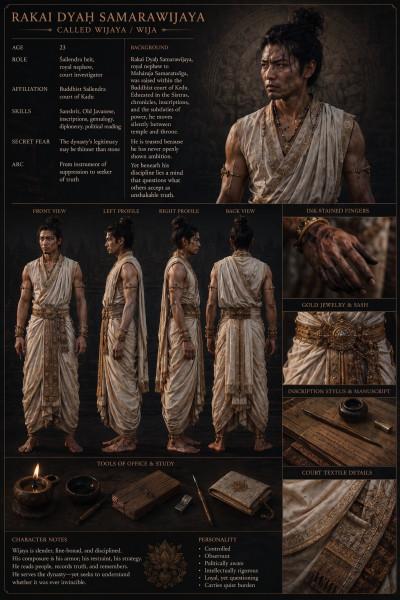
Rakai Dyaḥ Samarawijaya
Called: Wijaya, or (by intimates) Wija
Age: Twenty-three
Gender: Male
Status: Royal nephew to the reigning Mahārāja Samaratuṅga; son of a lesser queen, educated entirely within the Śailendra court at Kedu
Role: Tasked by his uncle to suppress the scandal of the altered inscription before the consecration ceremony. He is the court's instrument. He is elegant, controlled, and trusted precisely because he has never shown ambition for the throne.
Physical appearance: Slender, fine-boned, with the careful posture of a man trained from childhood in court ritual. He wears his hair oiled and bound in the style of the inner court. He has spent as many hours in the scriptorium as in the practice yard. He favors undyed cotton over silk when he is not required to dress for ceremony, which the court finds mildly eccentric.
Education and skills:
• Fluent in Sanskrit and Old Javanese; can read and compose inscriptions
•Trained in Buddhist philosophy, particularly Mahāyāna cosmology and the Vajrayāna ritual system patronized by the Śailendra court
• Skilled in the political language of court inscriptions. He understands that a genealogy is a weapon, that a land grant is an alliance, and that a temple name is a claim
• Moderate skill in unarmed combat, better skill in evasion, and reading a room
Inner world: Wijaya believes in the Borobudur. Not naively. He understands that it was built as much to awe subordinate rakrayān into loyalty as to honor the dharma. But he also believes the structure itself is true, that its terraces depict the path toward enlightenment.
He has spent his life making the Śailendra's constructed legitimacy seamless, filling gaps in the record, smoothing contradictions in genealogies. He is very good at it.
When the forged inscription appears, his first instinct is to suppress it. His second instinct is to wonder whether suppressing a lie about a lie is still justice.
Public persona: Loyal, discreet, slightly cold. The court reads him as ambitious-but-patient.
Secret fear: That his uncle's legitimacy is thinner than the stone it is carved on. That he has spent his adult life maintaining a fiction. That if he pulls the wrong thread, everything will unravel and that he will have been complicit in the unraveling.
PROTAGONIST TWO: THE ŚAIVITE HEIR
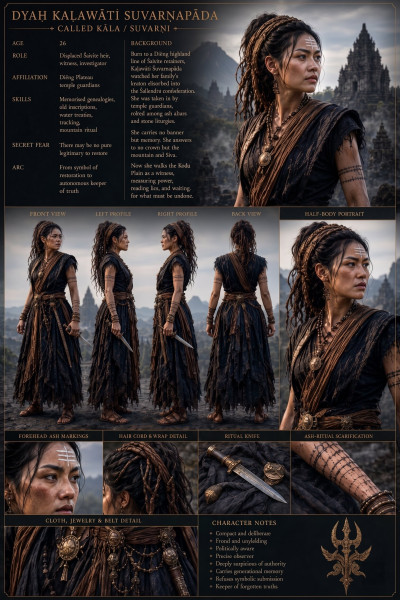
Dyaḥ Kaḷawāti Suvarṇapāda
Called: Kāla, or (by the priests who raised her) Suvarṇi
Age: Twenty-six
Gender: Female
Status: Surviving descendant of the Śaivite line connected to the Diëng Plateau cult. She was raised by displaced temple guardians after her family's kraton was absorbed into the Śailendra confederation
Role: She arrives at the consecration site as a problem. Her name appears in the forged inscription, in a list of those who "hold the memory of the first king." The court wants her arrested. Wijaya intercepts her first.